UPSC CSAT Topic-Wise Previous Year Questions
Previous year questions are one of the most useful ways to understand what the UPSC Civil Services Aptitude Test actually asks. But studying PYQs becomes more systematic when the questions are organised by subject, topic and subtopic.
Habitat IAS has organised UPSC CSAT questions from2011 to 2026 into a structured database so that aspirants can move directly from a broad subject to a particular topic and then practise the questions associated with it.
The complete collection covers 80 questions for each year from 2011 through 2026.
You can browse the completeUPSC CSAT PYQ collection, or go directly to thetopic-wise CSAT section.
Why Practise CSAT PYQs Topic-Wise?
A year-wise paper tells you what appeared in one examination. A topic-wise collection allows you to examine the same area across several examination years.
For example, instead of opening individual papers and manually locating questions related to number systems, you can open theNumber System topicand study the questions grouped there.
The same approach can be used for reading comprehension, quantitative aptitude, logical reasoning and the other classifications in the database.
CSAT Subjects in the Topic-Wise Database
The 2011–2026 database is organised into six subject-level classifications.
Passage-based questions involving comprehension, inference, interpretation, tone and related skills.
Numerical aptitude questions covering arithmetic, algebra, geometry, number systems and related topics.
Reasoning questions covering arrangements, statements, series, relations, coding and other logical structures.
Situation-based questions involving practical decision-making and judgement.
Questions based on interpreting numerical information and structured data.
Questions retained under the legacy or other CSAT classification.
The largest sections of the database areReading Comprehension,Quantitative Aptitude andLogical Reasoning. The remaining classifications preserve the questions assigned to Decision Making, Data Interpretation and Legacy / Other CSAT.
Quantitative Aptitude Topic-Wise PYQs
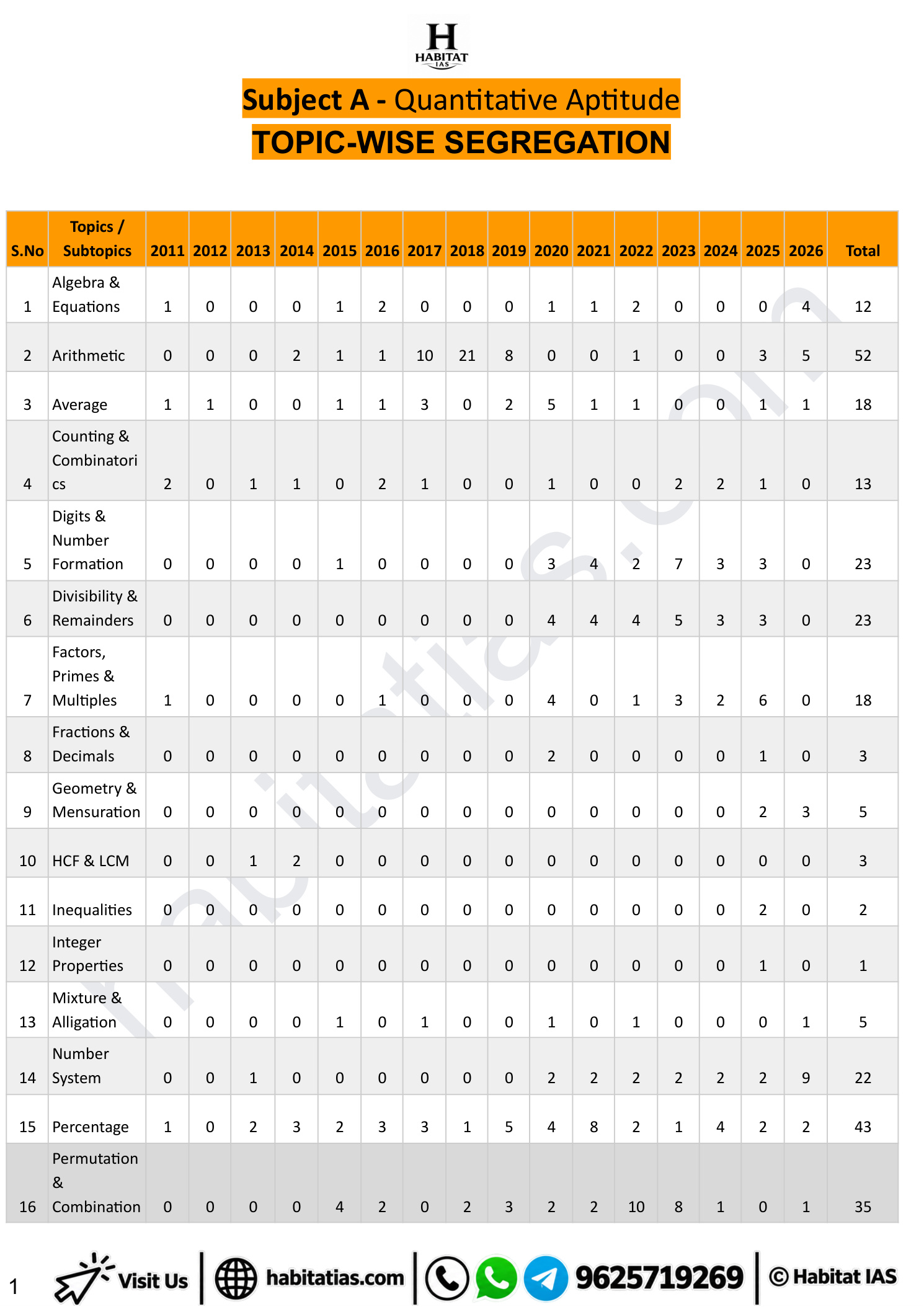
Quantitative Aptitude contains 410 questions in the current database. Its topic-wise organisation makes it possible to move from the complete quantitative section to individual areas.
One example isNumber System, which can be studied independently rather than mixed with every other quantitative question.
This is particularly useful when revising one area repeatedly: open the topic, review the historical questions, examine the explanations and then move totopic practice.
Reading Comprehension Topic-Wise PYQs
Reading Comprehension accounts for 468 questions in the current classification. Instead of looking only at individual years, aspirants can use the topic structure to review comprehension questions together.
This allows the question collection to function as more than an archive of old papers: it becomes a searchable and practice-ready reference for revision.
Logical Reasoning Topic-Wise PYQs
The Logical Reasoning classification contains 360 questions. These questions are organised further through the topic and subtopic hierarchy used by the CSAT database.
The topic-wise system is useful when your revision plan calls for a specific reasoning area rather than an entire year's paper.
Year-Wise CSAT PYQs from 2011 to 2026
Topic-wise practice does not replace the original year-wise papers. Both views serve different purposes.
Use the year-wise view when you want to recreate a complete paper. Use the topic-wise view when you want to concentrate on a particular concept or question category.
How to Use Topic-Wise CSAT PYQs for Revision
1. Identify the topic you want to revise
Begin with a topic rather than randomly selecting questions. This gives the practice session a specific purpose.
2. Attempt the previous year questions first
Try to solve the question before looking at the answer or explanation. The objective is to see how much of the topic you can handle independently.
3. Analyse the explanation
After attempting a question, compare your approach with the provided answer and explanation. Questions that required excessive time or repeated calculation can be marked for later revision.
4. Repeat the topic after a gap
A second attempt after some time can reveal whether the concept was actually understood or was only remembered from the first session.
5. Finish with mixed practice
After topic-focused practice, use theCSAT practice section for mixed question practice.
Topic-Wise PYQs vs Year-Wise PYQs
Both formats are useful, but they answer different study questions.
- Topic-wise: useful when revising a particular concept or question category.
- Year-wise: useful when attempting a complete historical paper.
- Subject-wise: useful when focusing on one broad CSAT area.
- Practice mode: useful when you want to attempt questions interactively and track your result.
Habitat IAS provides all of these routes from theCSAT PYQ hub.
Frequently Asked Questions
What does topic-wise CSAT PYQ practice mean?
Topic-wise CSAT PYQ practice means studying previous year questions after grouping them according to the subject, topic and subtopic to which they belong. This makes it possible to practise a particular area across multiple UPSC CSAT papers.
How many UPSC CSAT questions are available from 2011 to 2026?
The Habitat IAS CSAT database contains 1,280 questions from 2011 through 2026, with 80 questions represented for each year.
Which CSAT subjects can be practised topic-wise?
The database is organised into Reading Comprehension, Quantitative Aptitude, Logical Reasoning, Decision Making, Data Interpretation and Legacy / Other CSAT.
Can I practise only one CSAT topic?
Yes. The CSAT topic system provides permanent topic pages where questions can be viewed together and topic-specific practice can be started.
Are answers and explanations included?
Yes. The CSAT question database includes the answer and explanation associated with each question, along with the original question and its options.
Start Topic-Wise CSAT Practice
Explore the complete 2011–2026 collection and move directly from subject to topic to practice.
Explore CSAT Topics →