
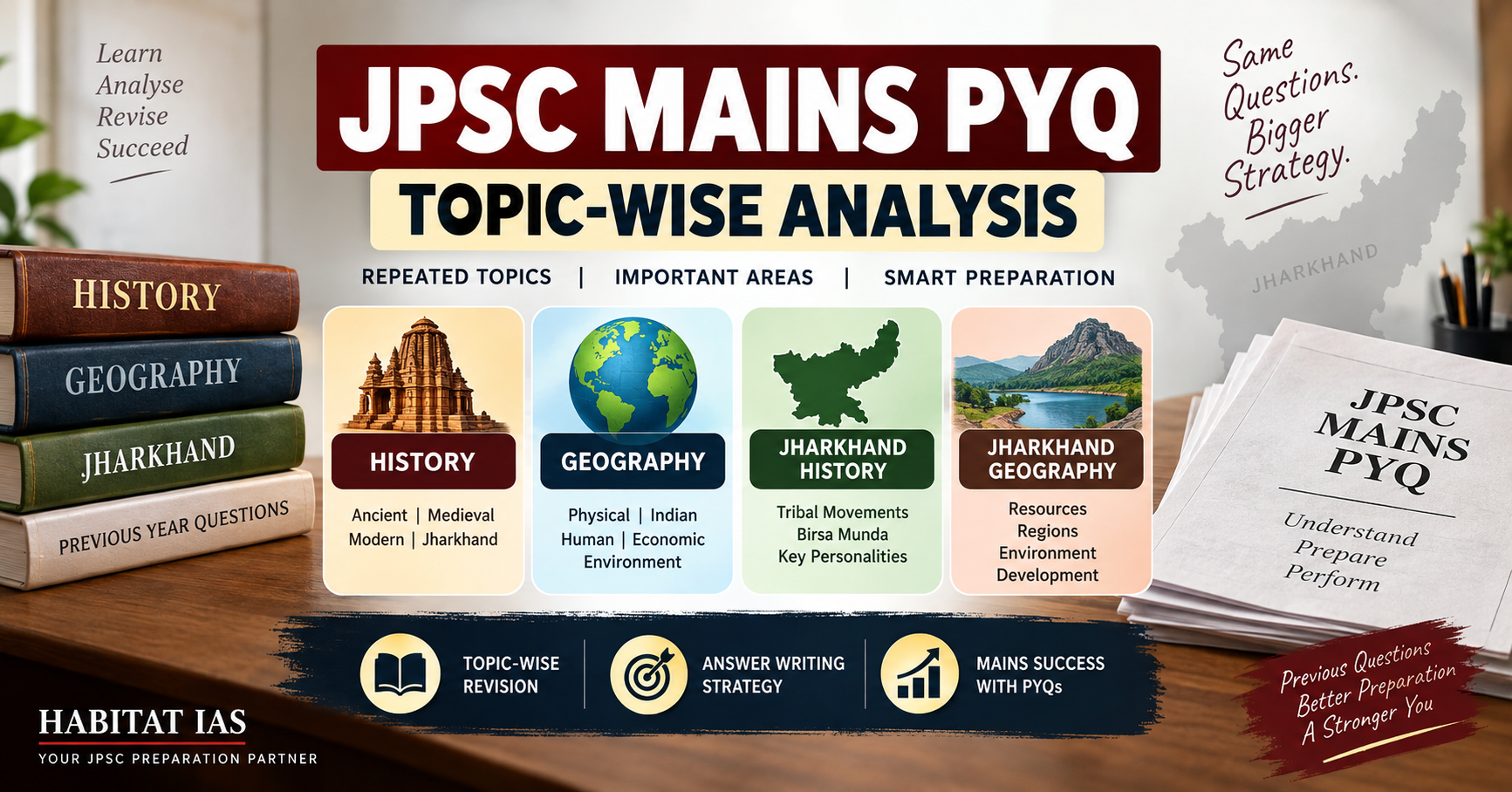
The 6th–13th JPSC Paper III frequency analysis shows that the strongest recurring areas includePhysical Geography, Modern India, Medieval India, Jharkhand Geography, Jharkhand History, Ancient India and Indian Geography.
One of the biggest mistakes in JPSC Mains preparation is studying every chapter with exactly the same priority.
Previous year questions allow you to see which areas have actually appeared across examination cycles.
The supplied JPSC Mains Paper III analysis covers the 6th to 13th JPSC examinations and classifies questions by subject, topic, subtopic and year.
This makes it possible to move from a simpleyear-wise PYQ listto a much more usefultopic-wise preparation system.
Table of Contents
JPSC Mains Topic-Wise PYQ: Why It Matters
JPSC Mains PYQs are most useful when they are studied in more than one way.
Understand what was asked in a particular examination cycle.
Separate History, Geography and other papers for focused preparation.
Connect related questions from different years.
Identify the exact area repeatedly tested.
For Paper III, the source specifically provides a detailed topic/subtopic frequency analysis for 6th–13th JPSC.
JPSC Mains Paper III Topic Frequency
The following figures are thetotal question countsin the supplied 6th–13th JPSC Paper III frequency table. They combine MCQs and descriptive questions.
Important JPSC Mains History Topics
The frequency analysis divides History into four major topic groups:Modern India, Medieval India, Jharkhand History and Ancient India.
Modern India
The highest-frequency History area in the supplied Paper III table.
- National Movement
- Major events and legislation
- Gandhi and the freedom struggle
- Modern political developments
Medieval India
A major recurring History area with both MCQs and descriptive questions.
- Delhi Sultanate
- Medieval administration
- Mughal period
- Reform policies and rulers
Jharkhand History
A distinct JPSC-specific component that deserves dedicated preparation.
- Birsa Munda
- Tribal movements
- Ulgulan
- Jharkhand historical movements
Ancient India
Important for both factual preparation and descriptive understanding.
- Indus Valley Civilization
- Early Indian civilisation
- Ancient administration
- Major cultural developments
Examples of recurring History themes
The source records descriptive questions in 2022 and 2024 concerning the impressive features and factors responsible for the origin of the Indus Valley Civilization.
The source includes 2019, 2022 and 2024 descriptive questions around Birsa Munda, the Sardar Movement, tribal struggle and Ulgulan.
Chola administration, Muhammad bin Tughlaq's token currency, Sher Shah Suri and Alauddin Khalji's market reforms appear in the descriptive PYQ set.
The source includes descriptive questions around Gandhi and the national movement and the Revolt of 1857.
Important JPSC Mains Geography Topics
Geography shows a particularly strong concentration aroundPhysical Geography and Jharkhand Geography, followed by Indian Geography.
Physical Geography
The highest-frequency Geography category in the supplied analysis.
- Earth interior
- Seismology
- Cyclones
- Climatology
Jharkhand Geography
State-specific geography is a major JPSC preparation area.
- Coal resources
- Land degradation
- Soil erosion
- Rural settlements
Indian Geography
Focus on India's physical, resource and geographical patterns.
- Natural vegetation
- Mineral resources
- Regional geography
- Indian geographical systems
Human Geography
Includes demographic, tribal and urbanisation-related themes.
- Demography
- Tribes
- Urbanisation
- Human geographical patterns
Examples from the Geography PYQ analysis
The source includes questions on seismology and the Earth's interior as well as tropical and temperate cyclones.
The descriptive set includes rural settlements, coal resources, and land degradation and soil erosion in Jharkhand.
Natural vegetation and mineral resources appear among the analysed Geography PYQs.
The source includes questions on the shifting location of India's sugar industry and factors behind the development of the iron and steel industry.
JPSC Mains Jharkhand-Specific Topics
Jharkhand should not be treated as a small appendix to the syllabus. The Paper III frequency table gives separate categories forJharkhand HistoryandJharkhand Geography.
Birsa Munda, tribal movements, Ulgulan and related historical developments.
Resources, coal, settlements, land degradation, soil erosion and state-specific geography.
Repeated Descriptive PYQ Themes
Topic frequency becomes even more useful when descriptive questions from different years are placed together.
Indus Valley Civilization
2022: impressive features of the Indus Valley Civilization.
2024: factors responsible for its origin.
Birsa Munda & Tribal Movements
2019: relationship between Birsa Movement and Sardar Movement.
2022: change in the methodology of tribal struggle after Birsa Munda.
2024: aspirations of peasants expressed through the religious idiom of Birsa's revolt.
Cyclones
2022: tropical cyclone weather, origin and path.
2024: tropical versus temperate cyclones.
Natural Vegetation
2022: relationship between annual rainfall and natural vegetation.
2024: characteristics and spatial distribution of vegetation types in India.
This is the real advantage of topic-wise PYQ analysis: questions from different years can reveal how the same broad area may be tested from different angles.
How to Prioritise JPSC Mains Topics
Do not interpret PYQ frequency as a prediction formula. Instead, use it to create a rational preparation order.
Complete the core syllabus and practise both objective and descriptive questions.
Build strong conceptual notes and solve all available PYQs.
Do not ignore them. Cover the syllabus basics after completing higher-frequency areas.
Revisit all topic clusters before the examination instead of relying only on high-frequency areas.
Topic-Wise JPSC Mains PYQ Revision Method
Step 1 — Create a topic list
Start with the major categories identified from the PYQ analysis.
Step 2 — Add every related PYQ
Put questions from 2019, 2022 and 2024 under the appropriate topic rather than keeping them isolated in separate notebooks.
Step 3 — Identify subtopics
For example, cyclones can be treated as a climatology-related cluster, while Birsa Munda questions can be studied as a connected tribal-history cluster.
Step 4 — Prepare one master note
Build a concise note capable of answering multiple related PYQs.
Step 5 — Practise all questions together
Once the note is ready, answer every PYQ belonging to that topic under timed conditions.
Step 6 — Update after each test
Add missing facts, examples and dimensions revealed during answer-writing practice.
Topic-Wise PYQ and JPSC Mains Answer Writing
Topic-wise PYQ analysis is particularly valuable for descriptive answer writing because several questions can test different dimensions of the same subject.
Discuss, analyse, critically examine, differentiate and explain require different structures.
Convert the topic into logical headings instead of writing one long paragraph.
Use India-specific and Jharkhand-specific examples wherever appropriate.
Do not reproduce everything you know. Address exactly what the examiner has asked.
Study JPSC Mains PYQs topic-wise
Instead of searching through individual years, useJPSC Mains Decoded: Topic-Wise PYQsto organise your previous year question preparation around subjects and topics.
- Topic-wise PYQ organisation
- Subject-wise coverage
- Previous year question analysis
- Systematic topic coverage
- Revision-oriented structure
- Digital PDF
Continue the PYQ-first approach for Prelims
UseJPSC Prelims Decoded: Topic-Wise PYQsto organise your Prelims preparation around previous year questions and important topics.
Test your preparation after PYQ revision
Complete the free JPSC GS Open Mock after revising your topic-wise PYQs.
Take Free JPSC GS Mock →Related JPSC Mains PYQ Articles
Frequently Asked Questions
What are the important topics in JPSC Mains?
The supplied 6th–13th JPSC Paper III analysis identifies Physical Geography, Jharkhand Geography, Indian Geography, Modern India, Medieval India, Jharkhand History and Ancient India among the major recurring topic areas.
Which JPSC Mains topics have the highest PYQ frequency in Paper III?
In the supplied frequency table, Physical Geography and Modern India each have 13 total questions, Medieval India has 12, Jharkhand Geography has 11, Jharkhand History has 9, and Ancient India and Indian Geography have 8 each.
Should JPSC Mains PYQs be studied year-wise or topic-wise?
Both. Year-wise study helps understand individual papers, while topic-wise study helps connect related questions from different examination cycles.
How can I use JPSC Mains PYQs for answer writing?
Group related descriptive questions by topic, identify the directive used in each question, prepare a common knowledge framework and practise answers using the original PYQ wording.
Stop revising JPSC Mains PYQs randomly.
Organise previous year questions by subject, topic and subtopic — then revise and practise complete question clusters.