
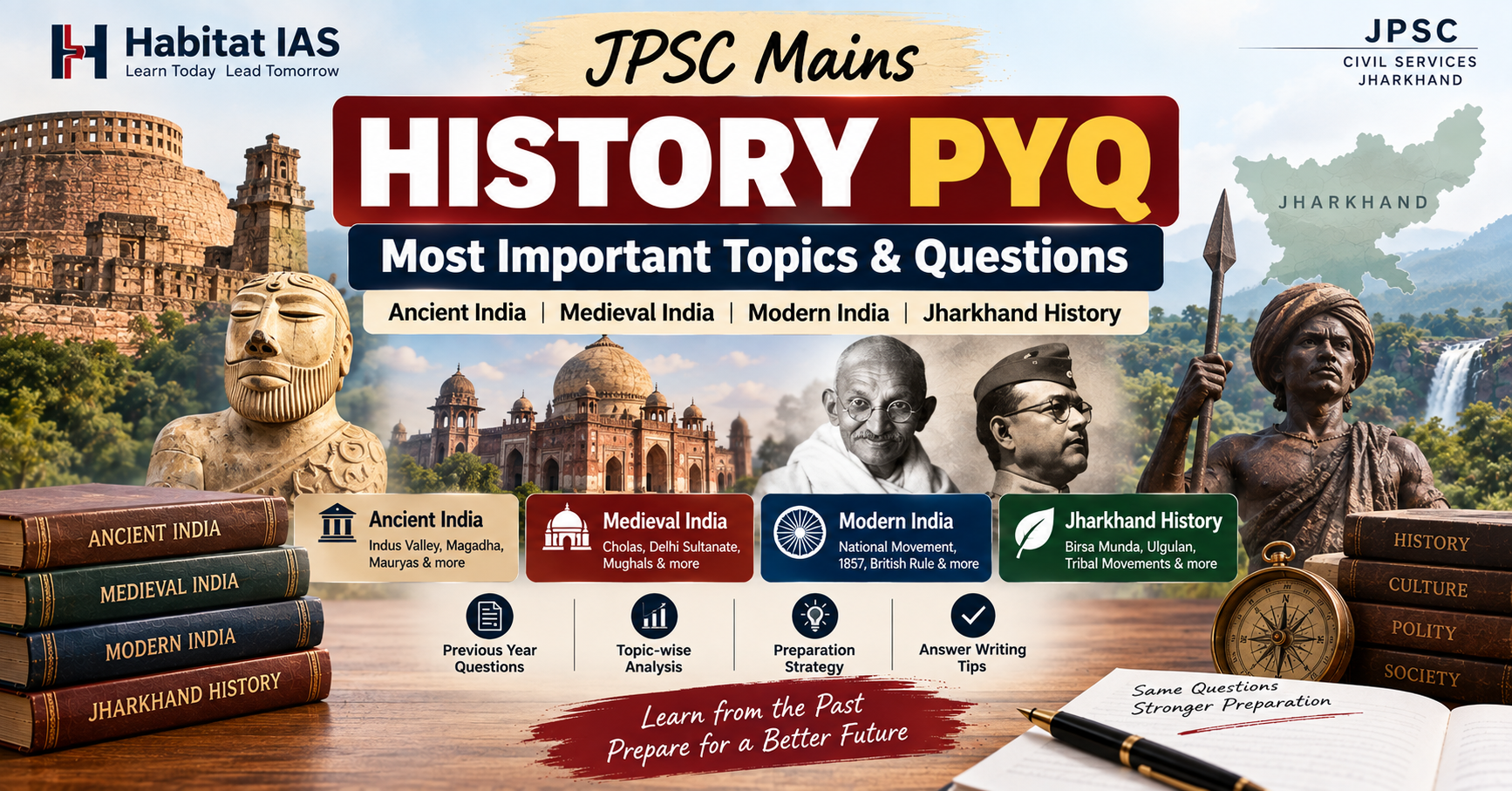
The JPSC Mains History PYQ pattern can be studied through four major areas:Ancient India, Medieval India, Modern India and Jharkhand History.
Previous year questions help identify the historical periods, personalities, movements, administrative systems and regional themes that JPSC has tested.
If you are preparing for JPSC Mains, studying History only chapter-by-chapter is not enough.
The better question is:What has JPSC actually asked?
That is whereJPSC Mains History PYQanalysis becomes useful.
Previous year questions show which historical periods, personalities, movements, administrative systems and regional themes have actually appeared in the examination.
This article therefore focuses on PYQ-based preparation rather than a generic list of History chapters.
Table of Contents
JPSC Mains History PYQ Topic Map
The 6th–13th JPSC Paper III analysis separates History into four major subject clusters.
These figures represent the identified questions in the topic-wise segregation of the 6th–13th JPSC Paper III material.
1. Ancient India — JPSC Mains History PYQ
Ancient India forms one of the four major History clusters in the analysed JPSC Mains Paper III material.
One particularly useful area is theIndus Valley Civilization.
JPSC has approached this area from different angles, including archaeological sites, material culture, geography and descriptive analysis.
Harappa was situated on the bank of which river?
Answer:Ravi
The beautiful figure of a dancing girl found at Mohenjo-daro was made of:
Answer:Bronze
Discuss the most impressive features of Indus Valley Civilization.
Which Harappan city is known for its impressive and unique water harvesting and management system?
Answer:Dholavira
Discuss the factors responsible for the origin of the Indus Valley Civilization.
The important lesson is that one broad historical area can generate different types of questions:
- Location-based questions
- Archaeological questions
- Factual MCQs
- Analytical descriptive questions
Ancient India topics to prepare
Origin, extent, important sites, town planning, drainage, water management, art and material culture.
Mahajanapadas, Magadhan expansion and important rulers.
Vedic society, republican traditions and major political developments.
Mauryan administration, Ashoka, art, architecture and major cultural developments.
2. Medieval India — JPSC Mains History PYQ
Medieval India is another major JPSC History cluster. Questions cover administration, military organisation, rulers, literature and economic policies.
Describe the main features of the local administration of Chola rulers.
Critically examine the policy of token currency of Muhammad Bin Tughlaq.
Critically examine the achievements and contribution of Sher Shah Suri.
Critically analyze the market reforms introduced by Alauddin Khalji.
These questions demonstrate that Medieval History preparation should go beyond dates and personalities. Administrative systems, reforms, causes, achievements and limitations also need to be prepared.
Medieval India topics to prepare
Local administration, institutions, maritime activity and cultural achievements.
Alauddin Khalji's reforms and Muhammad bin Tughlaq's administrative experiments.
Administration, revenue, roads, currency and broader contribution.
Military system, literature, culture and major rulers.
3. Modern India — JPSC Mains History PYQ
Modern India is the largest History cluster identified in the 6th–13th JPSC Paper III segregation.
The questions cover colonial expansion, social reform, the national movement, Gandhi, the Revolt of 1857 and revolutionary nationalism.
In which year did the Dutch land in India?
Answer:1605
'Mitra Mela' was later renamed as:
Answer:Abhinava Bharat Samiti
Swaraj Party was an outcome of which incident?
Answer:Chauri Chaura
Describe the role of Mahatma Gandhi in the Indian National Movement.
"The Revolt of 1857 was the First War of Indian Independence." Comment on the statement.
The Hindu Widows Remarriage Act was enacted in which year?
Answer:1856
Who was the Viceroy of India at the beginning of the Quit India Movement in 1942?
Answer:Lord Linlithgow
Modern India topics to prioritise
4. Jharkhand History — A High-Priority JPSC Area
Jharkhand History deserves separate preparation because it appears as its own History cluster in the JPSC Mains Paper III analysis.
One of the strongest recurring areas isBirsa Munda and the tribal movement tradition.
To what extent was the Birsa Movement influenced by the Sardar Movement? Discuss the effects of the Birsa Movement.
After Birsa Munda's movement, the struggle of tribals of Jharkhand gave up its militant and violent methodology and took constitutional and peaceful cause. How far do you agree?
The tribal revolt led by Birsa Munda expressed the aspirations of the peasants in religious idiom. Comment.
Notice how the broad theme remains important while the framing changes.
This is exactly why PYQ analysis is more useful than memorising a single "important question".
JPSC can retain thesame broad themewhile changing the analytical angle.
Other Jharkhand History areas to prepare
- Birsa Munda and Ulgulan
- Sardar Movement
- Tana Bhagat Movement
- Haribaba Movement
- Santhal movement
- Jharkhand tribal resistance
- Jharkhand and the Indian National Movement
Most Important JPSC Mains History Themes
Based on the analysed PYQs, the following themes deserve particularly systematic preparation.
Indus Valley Civilization
Sites, features, origin, town planning, water management, art and archaeology.
Medieval Administration & Reforms
Cholas, Alauddin Khalji, Muhammad bin Tughlaq and Sher Shah Suri.
Indian National Movement
Gandhi, major movements, revolutionary nationalism, Congress and important turning points.
Revolt of 1857
Causes, nature, leadership, regional dimensions and historical interpretation.
Birsa Munda & Ulgulan
Causes, tribal society, land question, religion, agrarian grievances and consequences.
Jharkhand Tribal Movements
Sardar, Tana Bhagat, Haribaba, Santhal and related movements.
Do Not Prepare MCQs and Descriptive Questions Separately
One common mistake in JPSC Mains History preparation is creating completely separate notes for objective and descriptive questions.
The PYQs show that one topic can be tested at different levels.
Identify a river, personality, organisation or date.
Understand why an event or institution developed.
Explain causes, consequences, significance and limitations.
Respond to verbs such as critically examine, analyse or comment.
JPSC Mains History Answer-Writing Strategy
Descriptive PYQs provide a ready-made answer-writing practice list.
Pay close attention to the command word in every question.
Explain the topic from multiple relevant dimensions.
Present the major features in a logical sequence.
Explain the issue and assess both strengths and limitations.
Break the issue into causes, relationships, consequences and significance.
Explain the statement and provide a balanced historical assessment.
A simple History answer structure
- Introduction:establish the historical context.
- Background:explain the conditions that led to the development.
- Main body:organise the answer using clear subheadings.
- Evidence:add personalities, events, examples and relevant facts.
- Analysis:explain significance, causes, consequences or limitations.
- Conclusion:provide a concise historical assessment.
How to Prepare JPSC Mains History Using PYQs
Step 1 — Complete the syllabus first
PYQs are not a replacement for the syllabus. Use the syllabus to establish the complete boundary of the subject.
Step 2 — Sort every PYQ by topic
Instead of keeping all questions under a year, create separate preparation groups for:
- Ancient India
- Medieval India
- Modern India
- Jharkhand History
Step 3 — Connect MCQs with descriptive questions
If an MCQ asks about a historical personality or event, ask yourself whether you can write a structured analytical answer on the same topic.
Step 4 — Track recurring themes
The Birsa Munda questions provide a good example: the broad theme recurs while the framing changes.
Step 5 — Practise answer writing from actual PYQs
Convert important descriptive PYQs into timed writing practice rather than simply reading model answers.
Step 6 — Revise topic-wise
Topic-wise revision can make PYQs more useful during the final revision phase because related questions are brought together.
Study JPSC Mains History PYQs topic-wise
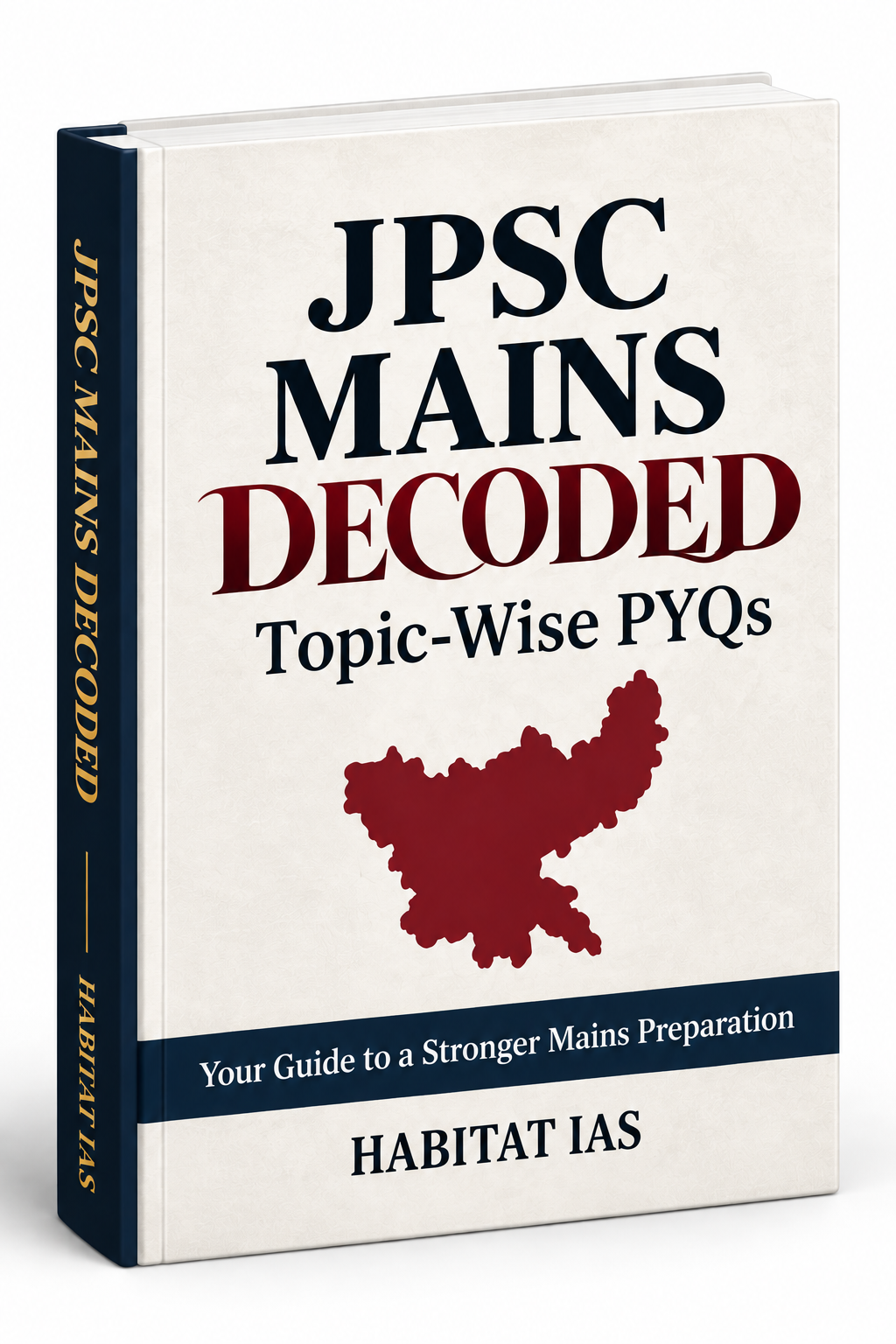
Instead of searching through different years and papers separately, useJPSC Mains Decoded: Topic-Wise PYQsto organise your Mains PYQ preparation around subjects and topics.
- Topic-wise PYQ organisation
- Mains-focused preparation
- Previous year question analysis
- Revision-oriented structure
- Digital PDF
Build your Prelims foundation with PYQs
After working through Mains History themes, use topic-wise previous year questions for your Prelims revision as well.
JPSC Prelims Decoded: Topic-Wise PYQsprovides a structured approach to previous year question preparation.
- Topic-wise PYQs
- Subject-wise organisation
- Detailed explanations
- Trend-oriented revision
- Jharkhand-specific coverage
Finished your History revision?
Test your broader General Studies preparation with the free JPSC GS mock.
Take Free JPSC GS Mock →JPSC Mains History PYQ: Quick Revision Checklist
Related JPSC Mains PYQ Articles
Frequently Asked Questions
Which History topics are important for JPSC Mains?
The analysed JPSC Mains Paper III material groups History into Ancient India, Medieval India, Modern India and Jharkhand History. Modern India is the largest identified cluster, followed by Medieval India, Jharkhand History and Ancient India.
Is Jharkhand History important for JPSC Mains?
Yes. Jharkhand History appears as a distinct recurring cluster and includes questions on Birsa Munda, Ulgulan and tribal movements.
Which Ancient History topic should I revise carefully?
The Indus Valley Civilization is particularly useful to study through PYQs because the analysed papers approach it through archaeological sites, material culture, water management and descriptive questions.
How should I prepare Modern History for JPSC Mains?
Combine conceptual preparation with PYQ-based revision. Give systematic attention to the national movement, Gandhi, the Revolt of 1857, revolutionary nationalism, socio-religious reform and colonial expansion.
Can PYQs help with JPSC Mains answer writing?
Yes. Descriptive PYQs should be used as direct answer-writing prompts. Pay attention to the wording of the question and practise responses using introductions, structured arguments, evidence, analysis and conclusions.
Prepare History from what JPSC actually asked.
Start with the PYQs, identify recurring themes, prepare topic-wise notes and practise the same analytical style in your answers.