
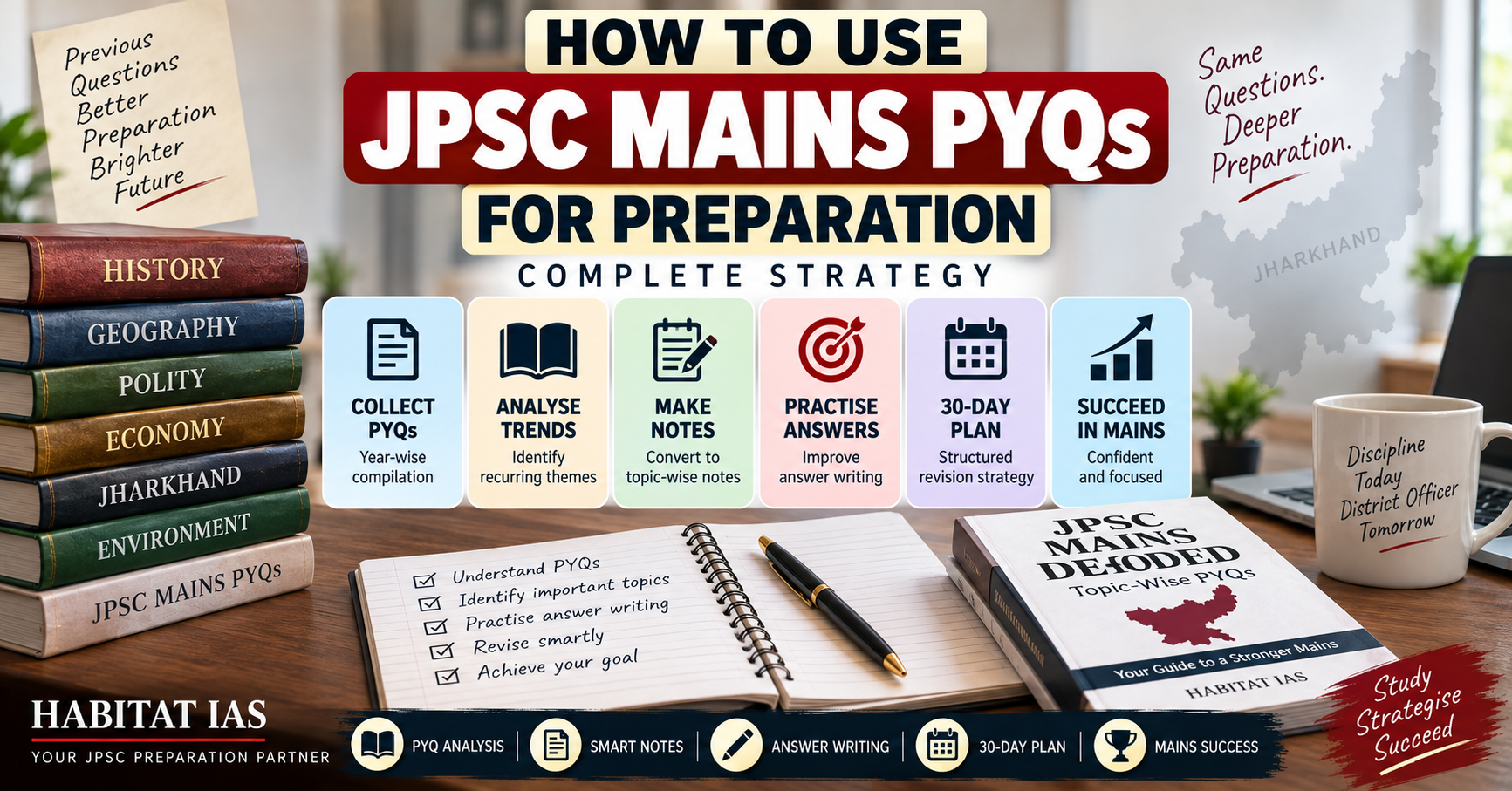
Do not use JPSC Mains PYQs only for last-minute question practice. Use them throughout preparation: first to understand the examination, then to organise topics, build notes, practise answers and revise.
Previous Year Questions are one of the most useful resources for understanding a competitive examination. They show what the examination has actually asked, rather than what students merely expect it to ask.
For JPSC Mains, PYQs become even more useful when they are connected with the syllabus and reorganised topic-wise.
A good PYQ strategy therefore has four stages:
Understand the actual questions asked.
Group questions according to subjects and topics.
Use descriptive PYQs for answer writing.
Return to the PYQ clusters repeatedly.
Table of Contents
- Why JPSC Mains PYQs Matter
- First Step: Study PYQs Year-Wise
- Connect PYQs With the Syllabus
- Convert PYQs Into Topic-Wise Notes
- Identify Recurring Themes
- Use PYQs for Answer Writing
- Connect PYQs With Current Affairs
- PYQ Revision Strategy
- 30-Day JPSC Mains PYQ Plan
- Common PYQ Mistakes
- JPSC Mains Decoded
- Frequently Asked Questions
Why JPSC Mains PYQs Matter
A syllabus tells you what can be studied. Previous year questions show you how the examination has actually approached that syllabus.
Understand the exam
PYQs reveal the type and wording of questions candidates have faced.
Find important areas
Grouping questions helps identify topics that have appeared repeatedly in the analysed set.
Improve preparation
PYQs help prevent preparation from becoming completely disconnected from the examination.
Practise answers
Descriptive PYQs provide authentic material for answer-writing practice.
Step 1: Study JPSC Mains PYQs Year-Wise
Start with the actual question papers before trying to create complicated topic lists.
Study each examination cycle separately and observe:
- Which subjects were covered?
- What types of questions were asked?
- Which questions were objective?
- Which questions required descriptive answers?
- What level of specificity was expected?
- Which areas appeared across different years?
Do not begin by asking, “What questions will come next?” Begin by asking, “What has JPSC actually asked?”
Step 2: Connect Every PYQ With the Syllabus
After reading a PYQ, locate the corresponding syllabus area.
This prevents PYQ preparation from becoming a separate activity disconnected from your normal study.
For example, a question about cyclones should not remain only in a “PYQ notebook.” It should connect to your Geography preparation and the relevant climatology concepts.
Step 3: Convert JPSC Mains PYQs Into Topic-Wise Notes
This is where PYQ preparation becomes much more powerful.
Instead of maintaining separate notes for every year, group related questions together.
Step 4: Identify Recurring JPSC Mains Themes
A recurring theme does not necessarily mean that the exact same question will be repeated.
More importantly, a broad topic can return through a different question, directive or dimension.
Example: Birsa Munda and Tribal Movements
Questions in the analysed PYQ material approach Birsa Munda and tribal movements from different angles. Therefore, preparing only one memorised answer would be insufficient.
A better preparation note would contain:
- Background
- Causes
- Nature of the movement
- Role of Birsa Munda
- Tribal aspirations
- Ulgulan
- Consequences
- Historical significance
Example: Cyclones
Geography preparation should similarly move beyond memorising one answer. A cyclone topic can be organised around origin, characteristics, movement, impacts and differences between major cyclone types.
Step 5: Use JPSC Mains PYQs for Answer Writing
Reading a descriptive PYQ and writing an answer are two different activities.
Once you have studied a topic, write the actual PYQ under examination-like conditions.
Identify whether the question asks you to discuss, analyse, explain, compare or examine.
Identify every component that needs to be addressed.
Organise the answer under clear headings.
End with a concise conclusion directly related to the question.
Step 6: Connect PYQs With Current Affairs
Current affairs should supplement static preparation, not replace it.
Once a PYQ topic has been identified, ask whether there are contemporary developments that help you understand or illustrate that topic.
This approach can make descriptive answers more relevant without turning the answer into a current affairs essay.
Step 7: Build a PYQ Revision System
Your PYQ notebook should become smaller and more useful as preparation progresses.
Read every question and classify it.
Revise topic clusters and important concepts.
Practise descriptive questions.
Rapidly revise the question-topic framework.
30-Day JPSC Mains PYQ Revision Strategy
A dedicated PYQ revision month can be divided into four phases.
Understand
Read the available PYQs and classify them year-wise and subject-wise.
Organise
Convert the questions into topic-wise clusters and identify major recurring themes.
Practise
Write answers to selected descriptive PYQs under timed conditions.
Revise
Revise your topic framework and rewrite weak answers.
Common Mistakes While Using JPSC Mains PYQs
Reading questions without attempting them does not develop answer-writing ability.
Memorisation alone cannot prepare you for a differently worded question.
PYQs should be connected to the syllabus rather than treated as an isolated resource.
A wider PYQ set gives a better view of recurring themes across examination cycles.
Jharkhand History and Geography deserve their own focused preparation.
Frequency is useful for prioritisation, but it should never replace complete syllabus coverage.
Organise Your JPSC Mains PYQs Topic-Wise
If you want to follow a PYQ-first preparation strategy without manually sorting questions from different examination cycles, use:
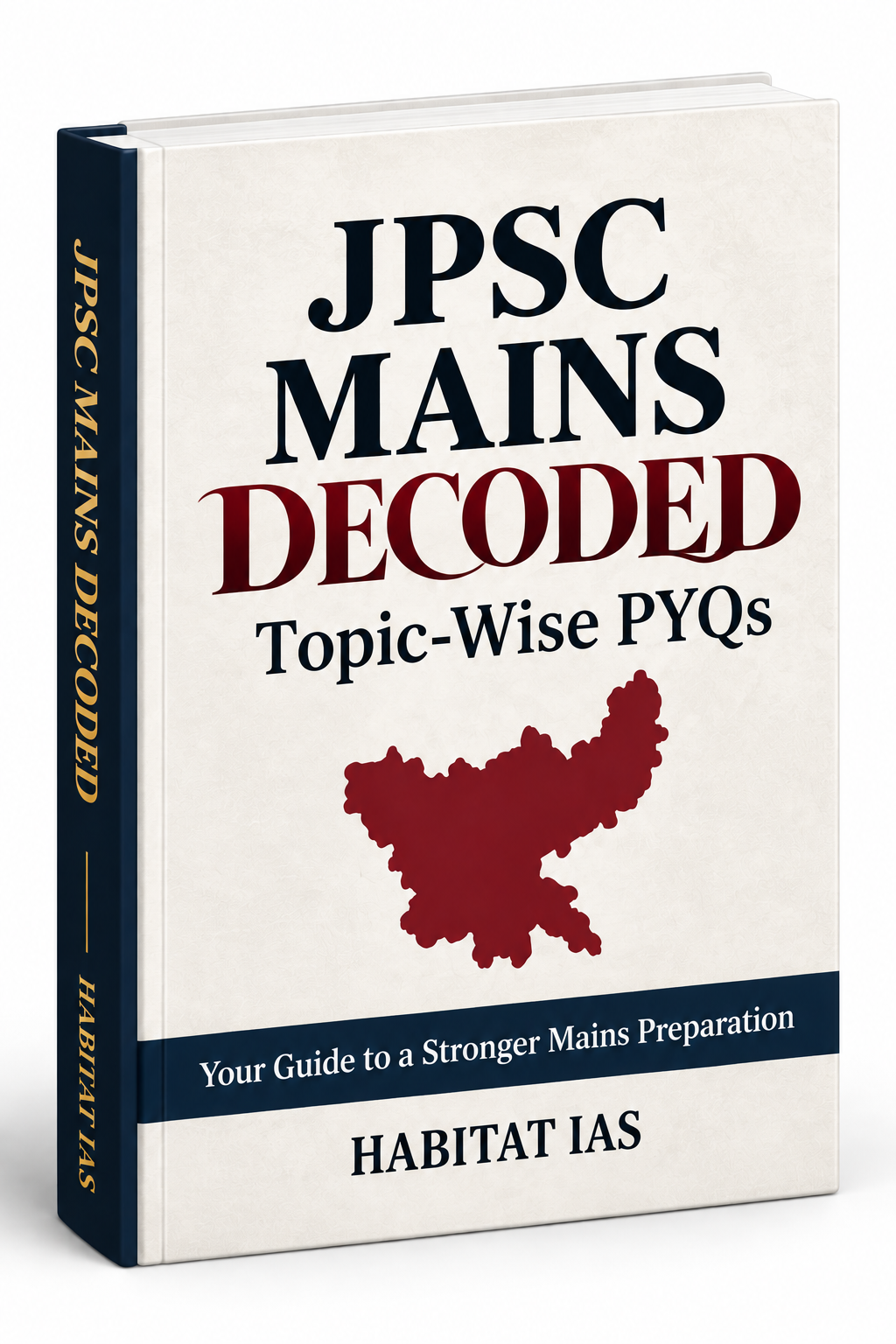
JPSC Mains Decoded: Topic-Wise PYQs
- Topic-wise PYQ organisation
- Mains-focused preparation
- Previous year question analysis
- Systematic topic coverage
- Revision-oriented structure
- Digital PDF
Continue the PYQ-First Approach for Prelims
The same principle can be applied to JPSC Prelims. Organise previous year questions by subject and topic, analyse trends and revise systematically.
Now Test What You Have Studied
After studying PYQs and revising important topics, attempt a free JPSC General Studies mock to test your preparation.
Take Free JPSC GS Mock →Continue Your JPSC Mains PYQ Preparation
Frequently Asked Questions
How should I use JPSC Mains PYQs?
Study them year-wise first, then reorganise them topic-wise, connect them with the syllabus, identify recurring themes and practise descriptive answers.
How many years of JPSC Mains PYQs should I study?
A broad PYQ set is more useful than focusing exclusively on one examination cycle. Studying questions across examination cycles allows you to see recurring subjects and themes.
Are JPSC Mains PYQs useful for answer writing?
Yes. Descriptive PYQs show how the examination has actually framed analytical and explanatory questions and therefore provide useful answer-writing practice material.
Should I memorise JPSC Mains PYQs?
No. Use them primarily to understand the syllabus, themes, question framing and required dimensions. Memorisation alone is not a reliable preparation strategy.
Prepare From What JPSC Has Actually Asked
Study the PYQs. Organise the topics. Practise the answers. Revise systematically.