
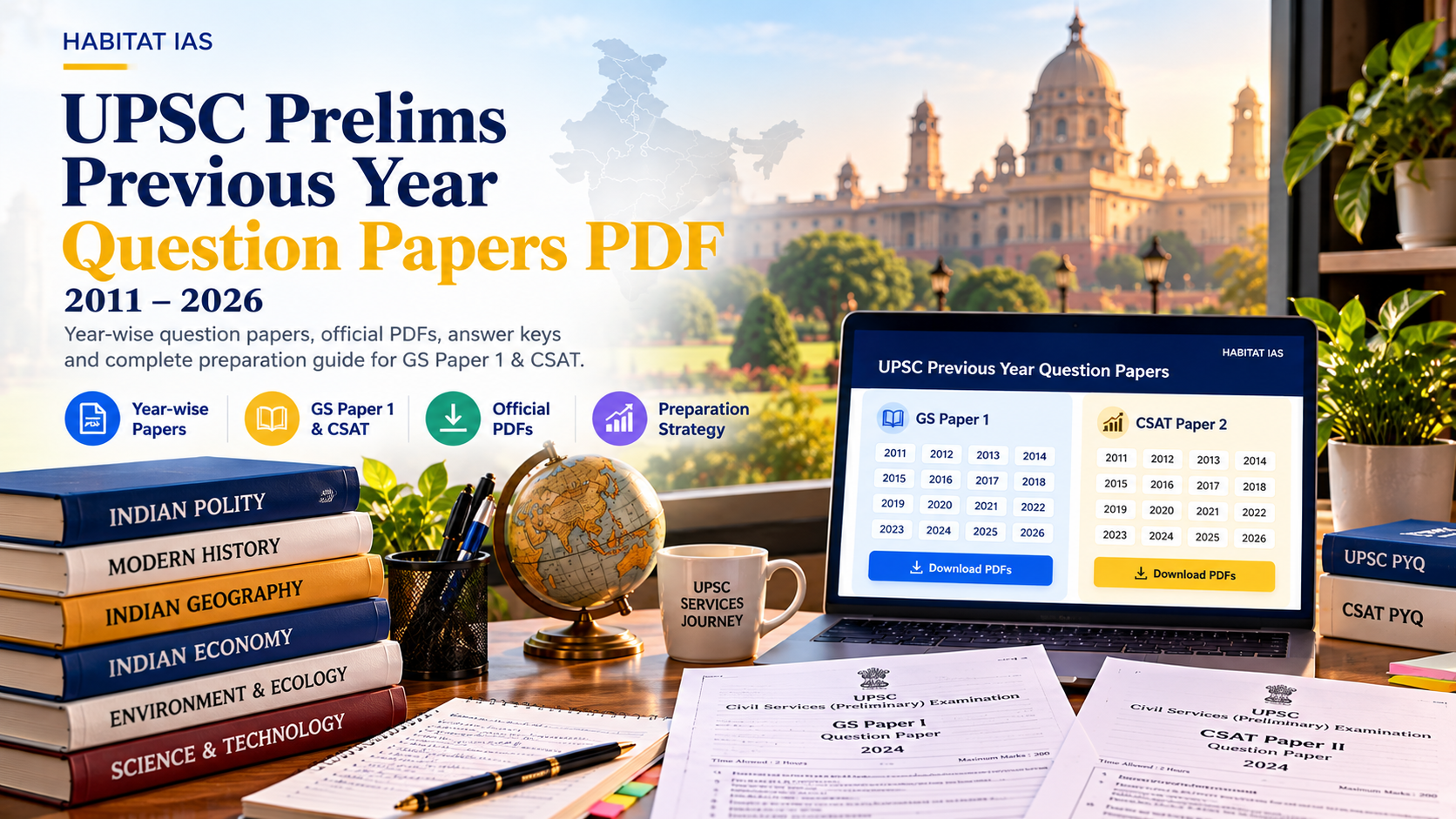
UPSC Prelims Previous Year Question Papers PDF: How to Use Them Effectively
Previous Year Questions (PYQs) are an important part of UPSC Civil Services Preliminary Examination preparation. They help aspirants understand how the syllabus is assessed, practise careful reading and identify concepts that need more attention. However, simply downloading a collection of PDFs is not enough. The real benefit comes from attempting questions, checking the reasoning and revisiting mistakes.
This guide explains how to organise UPSC Prelims question papers year-wise, how to approach GS Paper-I and CSAT Paper-II, and how to move from full-length papers to focused topic-wise practice.
For online GS practice, visit UPSC Prelims Decoded (PYQ) by Habitat IAS. For aptitude-focused preparation, use the separate UPSC CSAT Topic-Wise PYQ resource.
Which UPSC Prelims Question Papers Should You Practise?
The Civil Services Preliminary Examination has two papers with different purposes. Prepare for them separately and keep your records distinct.
General Studies (GS)
Questions draw on areas such as History, Geography, Polity, Economy, Environment, Science and Technology, and current developments.
Explore GS Paper-I PYQs →CSAT
Practice comprehension, logical reasoning, analytical ability, basic numeracy and data interpretation as relevant to the syllabus.
Explore CSAT Topic-Wise PYQs →Do not assume that strong performance in GS automatically means that CSAT is ready. Assess your ability in each paper independently and plan practice accordingly.
How to Organise UPSC Prelims Papers from 2011 to 2026
A year-wise collection helps you see a paper in its original structure. It is useful for timed attempts, reviewing paper-level performance and observing how questions are framed across different subjects.
- Create a year-wise folder. Keep GS Paper-I and CSAT Paper-II clearly separated for each year.
- Record the source. Prefer official question papers where available and note whether a PDF is an original paper, a scan or a reformatted copy.
- Keep answer keys separate. Record which answer key you used and revisit questions where sources disagree.
- Track your attempts. Note correct, incorrect, unattempted and uncertain responses rather than recording only a total score.
- Review the paper after attempting it. Classify mistakes by subject and concept so that the next revision is specific.
Use the Habitat IAS question interface to navigate the GS Paper-I PYQ collection.
How to Use GS Paper-I Question Papers
Start by attempting a paper or a manageable set of questions without looking at the answers. After the attempt, analyse the concepts tested instead of limiting the review to the final score.
Identify the subject
Classify the question under the most relevant syllabus area, while noting genuine overlaps between subjects.
Understand the concept
Read enough to explain why the correct answer is supported and what knowledge the question tests.
Check each option
Understand the specific error or unsupported claim in an incorrect option wherever possible.
Plan revision
Return to the source material for concepts that caused errors, guesses or repeated confusion.
Use year-wise papers to practise the overall examination experience and subject-wise or topic-wise questions to work on specific weaknesses. These methods complement each other.
Explore subject-wise UPSC Prelims PYQs →UPSC CSAT Question Paper PDFs: Practise Separately
CSAT requires a different practice routine from GS Paper-I. It is useful to identify your stronger and weaker areas through actual questions and then practise those areas consistently.
Reading and inference
Practise identifying the central argument, drawing supported inferences and avoiding assumptions that the passage does not justify.
Logical and analytical ability
Work through problems methodically and review the reasoning steps, not just the selected option.
Quantitative aptitude
Practise calculations and numerical concepts relevant to the prescribed syllabus, while monitoring accuracy and time.
After attempting a CSAT paper, categorise errors: concept not understood, calculation mistake, misread question, poor time allocation or an unsupported guess. The category should determine what you practise next.
How to Use UPSC Prelims Answer Keys and Solutions
An answer key helps you evaluate an attempt, but a score alone does not explain what you need to learn. Use the key as the starting point for analysis.
- Verify the source: distinguish an official answer key from an unofficial solution or coaching institute's suggested answers.
- Investigate disputed questions: compare reliable references when the answer is unclear or sources disagree.
- Review incorrect options: identify the exact reason an option is wrong instead of relying on a memorised letter.
- Record uncertainty: mark correct guesses separately from answers you could confidently justify.
- Update your notes: capture the underlying concept in concise language that will be useful during revision.
How to Study with UPSC PYQ PDFs: Step by Step
Choose a paper for a clear purpose
Decide whether you are testing overall readiness, revising a subject or practising a specific topic.
Attempt before reading solutions
Work independently first. If practising under timed conditions, avoid pausing to look up facts.
Evaluate more than the score
Record the answer, confidence level, time taken and reason for each mistake where practical.
Classify mistakes
Separate factual gaps, conceptual confusion, misreading, calculation errors and weak elimination.
Revise and reattempt
Review the relevant concept and return to difficult questions after an interval to test genuine learning.
Why Combine Question Paper PDFs with Topic-Wise PYQs?
Full papers preserve the original examination structure. Topic-wise practice lets you compare related questions across years and focus on a particular area. Both are useful, but for different reasons.
| Approach | Useful for | When to use it |
|---|---|---|
| Year-wise paper | Full-paper practice and timing | When checking overall readiness |
| Subject-wise PYQ | Reviewing a broad subject | After studying or revising that subject |
| Topic-wise PYQ | Focused concept practice | After learning a specific topic or analysing a recurring error |
UPSC Prelims Decoded (PYQ)
Explore the GS Paper-I question collection using year-wise, subject-wise and topic-wise navigation.
Explore UPSC Prelims Decoded →For CSAT, follow the separate CSAT Topic-Wise PYQ route. Keeping the two papers distinct makes it easier to track the different skills each one requires.
Common Mistakes When Using UPSC Previous Year Papers
Downloading papers but not analysing them
A large folder of PDFs is not a preparation strategy unless you attempt, evaluate and revise from them.
Memorising answer letters
Answer letters have little value without understanding the concepts and the reasoning behind the options.
Mixing GS and CSAT tracking
Track each paper independently so that strengths in one do not hide weaknesses in the other.
Treating past patterns as guarantees
PYQs help you understand the examination, but they cannot predict the exact questions in a future paper.
Ignoring source quality
Check paper versions and answer-key sources, especially where a question or solution appears disputed.
Turn UPSC Question Papers into a Revision System
Use year-wise papers to test your overall preparation, then analyse each question and revise the underlying concept. Follow that with subject-wise or topic-wise practice to work on identified weaknesses.
Start with UPSC Prelims Decoded (PYQ) for GS Paper-I, and use UPSC CSAT Topic-Wise PYQ for the aptitude paper.
Frequently Asked Questions
Where can I find UPSC Prelims previous year question papers?
You can look for official question papers through UPSC's official website and use the Habitat IAS UPSC Prelims Decoded resource for online GS Paper-I PYQ navigation.
Should I practise GS Paper-I and CSAT papers separately?
Yes. They assess different areas and should be tracked separately. Use CSAT Topic-Wise PYQ for focused aptitude practice.
Are solved UPSC PYQ PDFs enough for preparation?
No single resource is enough on its own. Use question papers to practise, verify answers carefully, study the underlying concepts and revise your mistakes.
Is year-wise practice better than topic-wise practice?
They serve different purposes. Year-wise practice helps you experience a complete paper, while topic-wise practice helps you focus on particular concepts. A balanced plan uses both.
How should I review incorrect answers?
Identify whether the error came from a knowledge gap, conceptual confusion, misreading, calculation or elimination. Revise the cause and reattempt the question later.
Where can I find CSAT topic-wise previous year questions?
Visit the Habitat IAS UPSC CSAT Topic-Wise PYQ page for the dedicated CSAT resource.