
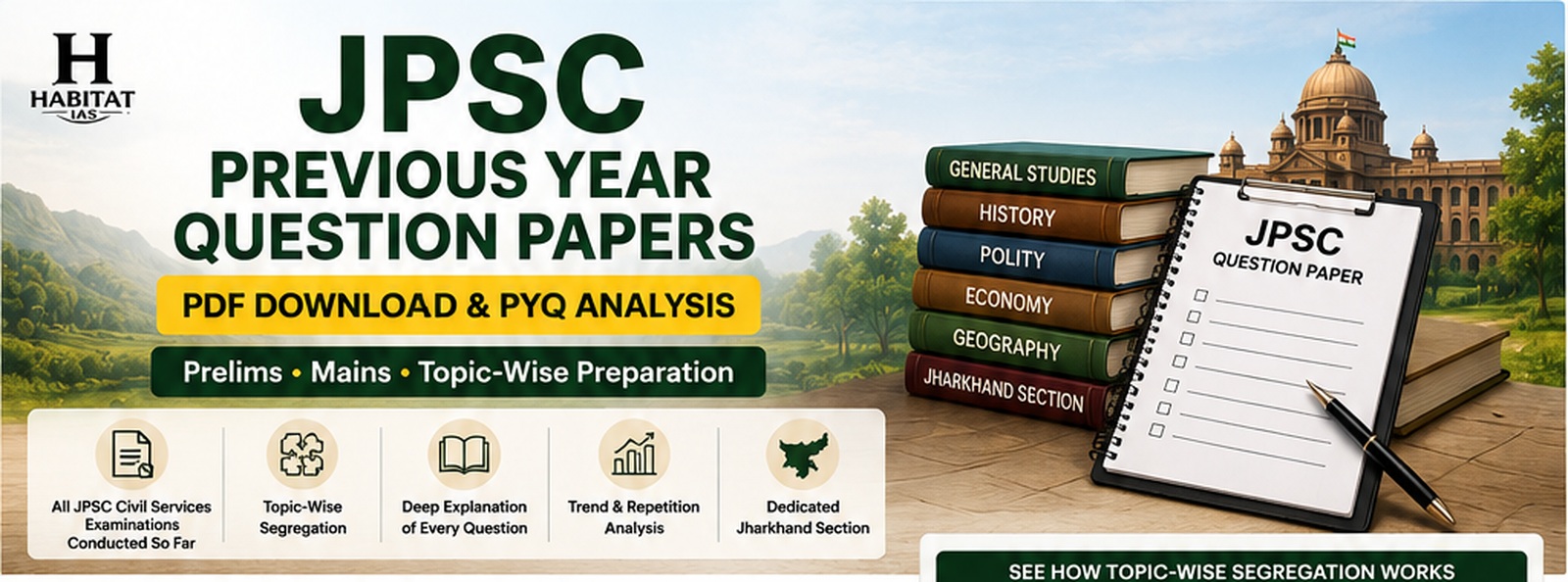
JPSC PYQ PDF Download – Previous Year Questions with Answers
JPSC Previous Year Questions are among the most useful resources for understanding how the Combined Civil Services Examination has actually tested different subjects and topics. A JPSC PYQ PDF can help candidates practise genuine examination questions, while answers and explanations make the practice more useful for learning and revision.
However, simply downloading a PDF and memorising the correct option is not enough. The real value of a previous year question comes from understanding the concept behind it, identifying the topic being tested and comparing similar questions across the examination cycles actually conducted.
1. What Is a JPSC PYQ PDF?
A JPSC PYQ PDF is a digital collection of previous questions asked in JPSC Combined Civil Services examinations. Depending on the source, a PDF may contain the original question paper, an answer key, explanations, or a combination of these.
For serious preparation, candidates should distinguish between simply possessing a paper and actually analysing the questions contained in it.
- What type of question was asked?
- Which subject does the question belong to?
- Which specific topic or sub-topic was tested?
- Why is the correct answer correct?
- Why are the other options incorrect?
- Has a similar concept appeared in another examination cycle?
2. JPSC PYQ PDF Download – What Should You Look For?
When searching for a JPSC PYQ PDF download, candidates should first identify the examination and paper they actually need. Different JPSC examination cycles and papers should not be mixed together without checking their context.
A useful PYQ collection should make it possible to move from the original question paper to systematic analysis.
| Resource | What It Provides | Best Use |
|---|---|---|
| Original JPSC Question Paper | Actual questions from the examination | Understanding the original paper |
| Answer Key | Correct answer options | Checking performance |
| Explained PYQs | Answer plus conceptual explanation | Learning and revision |
| Topic-Wise PYQs | Related questions grouped together | Trend and repetition analysis |
3. JPSC PYQ With Answers Is Better Than an Answer Key Alone
An answer key tells you which option is considered correct. It does not necessarily explain the underlying concept.
This distinction is important because a candidate may correctly remember one answer without understanding the principle, fact or relationship tested by the question.
Question
What concept is the question testing?
Answer
Which option is correct?
Explanation
Why is that option correct, what concept does it represent and what should the candidate remember for future questions?
Analysis
Which subject and topic does the question belong to, and does the same area recur elsewhere in the JPSC PYQ set?
This approach converts PYQ practice from simple answer checking into a structured learning process.
4. How to Use JPSC PYQs With Answers
The most effective approach is to solve first and analyse later. Looking at the answer before attempting the question reduces the diagnostic value of the PYQ.
- Attempt the question without looking at the answer.
- Record whether you were confident or uncertain.
- Check the correct answer.
- Read the complete explanation.
- Identify the subject and topic.
- Note the reason for your mistake.
- Check whether a related concept appears elsewhere.
- Add important concepts to your revision list.
- Re-attempt difficult questions during revision.
5. What Can JPSC Previous Year Questions With Answers Reveal?
A collection of solved PYQs can reveal more than individual correct answers. When questions from the examination cycles actually conducted are analysed together, patterns in subject emphasis and recurring concepts become easier to identify.
- Frequently tested subjects
- Repeated concepts
- Important sub-topics
- Question distribution
- Difficulty and question style
- Jharkhand-specific emphasis
- Areas requiring additional revision
6. Topic-Wise Analysis of JPSC PYQs
The next step after collecting and solving PYQs is classification. Questions can be grouped according to subject and then divided into meaningful topics and sub-topics.
General Studies
- History
- Geography
- Polity and Governance
- Economy
- Environment and Ecology
- Science and Technology
- Current Affairs
Jharkhand-Specific Areas
- Jharkhand History
- Jharkhand Geography
- Jharkhand Economy
- Jharkhand Polity and Administration
- Jharkhand Culture
- Tribes and Communities
- Jharkhand Schemes and Development
- Jharkhand Current Affairs
7. Why Detailed Explanation of Every Question Matters
A question should ideally be treated as a learning unit rather than merely as an examination item.
Detailed explanation can help a candidate understand the factual information, conceptual relationship or reasoning involved in the question. It can also reveal what additional information should be revised before the next attempt.
- Answer practice
- Concept revision
- Topic identification
- Mistake analysis
- Trend analysis
- Future revision
8. JPSC Current Affairs PYQ Analysis
Current Affairs is particularly suitable for detailed categorisation because questions can cover many different types of events and information.
Instead of treating Current Affairs as one large category, questions can be classified into smaller areas such as:
- Sports
- Prizes, Awards and Titles
- Events and Summits
- Authors and Books
- Festivals
- Operations and Military Exercises
- Persons and Species in News
- Important Dates
- Government Schemes
- States in News
- Countries in News
- Miscellaneous Current Affairs
Such segregation can make it easier to understand what types of Current Affairs questions have actually appeared and where additional preparation may be required.
9. Year-Wise JPSC PYQ vs Topic-Wise JPSC PYQ
Both methods have a place in preparation. A year-wise paper preserves the original examination structure, while topic-wise organisation helps candidates compare related questions.
| Year-Wise PYQ | Topic-Wise PYQ |
|---|---|
| Preserves the original paper structure. | Groups related questions together. |
| Useful for complete-paper practice. | Useful for focused revision. |
| Questions remain distributed across papers. | Similar concepts can be compared directly. |
| Trend identification may require additional work. | Recurring topics become easier to identify. |
| Excellent for simulating the examination. | Excellent for analysis and targeted preparation. |
JPSC Prelims PYQ Decoded – Beyond a Basic PYQ PDF
A downloadable JPSC PYQ PDF can give you access to previous questions. But for serious preparation, the greater value comes from knowing what each question represents, how it connects with a topic and what patterns can be identified across examinations.
The Habitat IAS JPSC Prelims PYQ book follows this broader approach. It brings together PYQs from JPSC Combined Civil Services examinations conducted so far and organises them topic-wise.
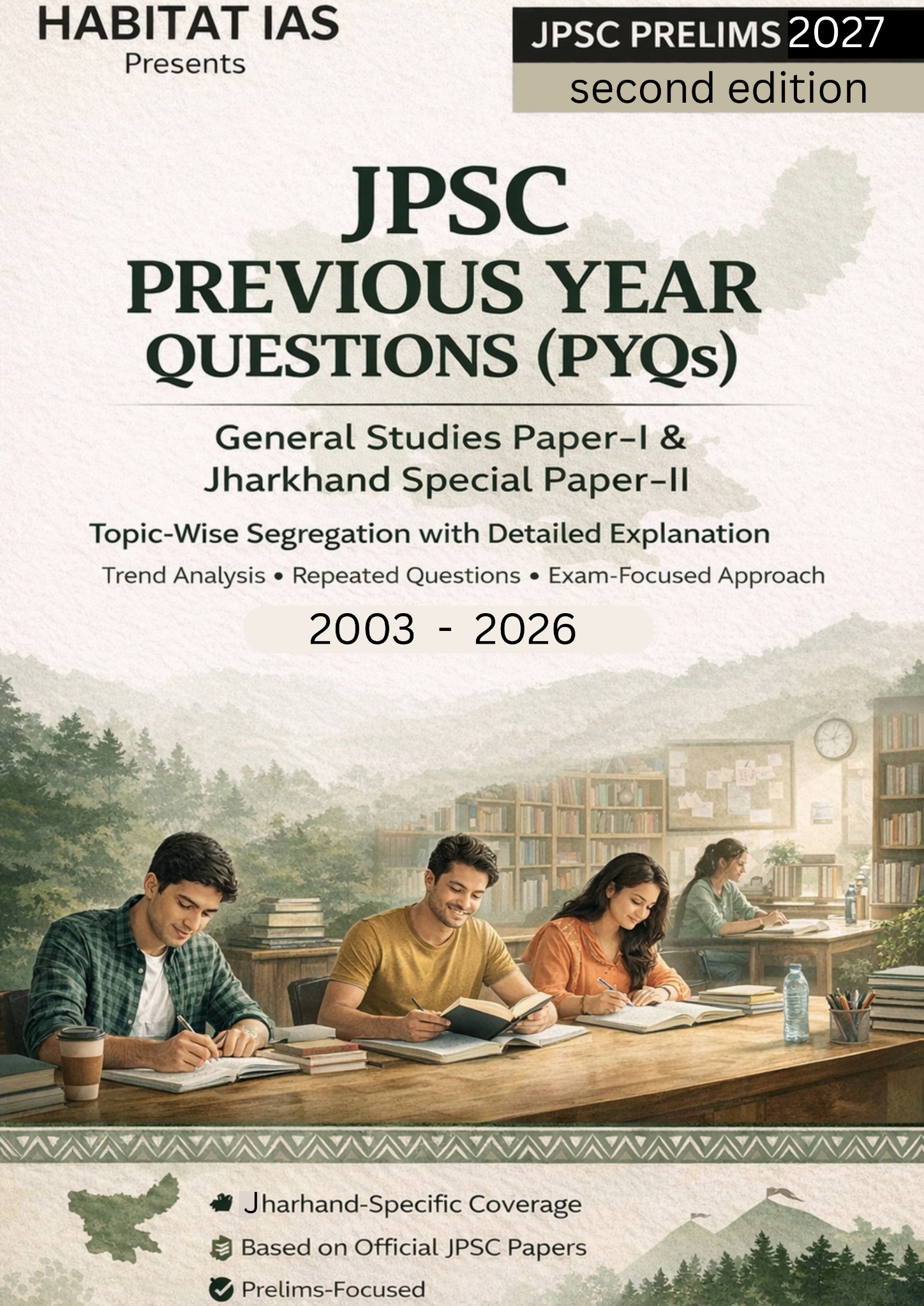
JPSC Prelims PYQ Decoded – Habitat IAS
What the book focuses on
- PYQs from JPSC Combined Civil Services examinations conducted so far.
- Topic-wise segregation of questions.
- Deep explanation of every question.
- Trend and repetition analysis.
- General Studies subject-wise coverage.
- Dedicated Jharkhand-specific section.
- Exam-focused organisation for JPSC Prelims preparation.
The approach is designed to help candidates move from simply asking:“What is the correct answer?”to asking:“What concept was tested?”“Where does it fit in the syllabus?”and“Does this topic show a recurring pattern?”
10. Why Solve JPSC PYQs Before Mock Tests?
Mock tests are useful for practice and performance measurement, but PYQs have a different role: they expose candidates to actual examination questions from the relevant examination cycles.
A useful sequence is to study the syllabus, solve and analyse PYQs, revise weak areas and then use mock tests to assess preparation.
- Study the relevant syllabus.
- Solve JPSC PYQs.
- Analyse answers and explanations.
- Identify weak topics.
- Revise those topics.
- Attempt fresh mock tests.
- Revisit PYQ mistakes during revision.
11. Common Mistakes While Using JPSC PYQ PDFs
- Downloading PDFs but not solving them.
- Looking at the answer before attempting the question.
- Memorising only the correct option.
- Ignoring detailed explanations.
- Not identifying the topic behind each question.
- Ignoring recurring concepts.
- Treating every calendar year as an examination year.
- Neglecting Jharkhand-specific preparation.
- Solving PYQs only once.
Don't Just Download JPSC PYQs. Analyse Them.
Use previous year questions to understand the examination, study the explanations, identify recurring concepts and build a more focused JPSC Prelims preparation strategy.
Get JPSC PYQ Book →Frequently Asked Questions About JPSC PYQ PDF
Where can I find JPSC PYQ PDFs?
JPSC PYQs should be collected from reliable sources and matched to the JPSC Combined Civil Services examination cycles actually conducted. Always verify the examination and paper before using a PDF.
Are JPSC PYQs available with answers?
JPSC previous year questions may be available with answer keys or explanations depending on the source. For serious preparation, candidates should study both the correct answer and the reasoning behind it.
Why should I solve JPSC PYQs with explanations?
Explanations help candidates understand why an answer is correct, identify conceptual gaps and connect individual questions with broader syllabus topics.
Should JPSC PYQs be studied year-wise or topic-wise?
Both approaches are useful. Year-wise papers preserve the original examination experience, while topic-wise organisation helps identify recurring concepts, topic distribution and preparation priorities.
What is the benefit of a topic-wise JPSC PYQ book?
A topic-wise JPSC PYQ book brings related questions together, provides detailed explanations and makes recurring topics and trends easier to analyse.